
A client messages: "Magkano po para sa 18x24 na portrait?" (How much for an 18 x 24 portrait?) Most artists answer by checking what a friend charges, then going a little lower to win the job.
That habit turns a ₱1,500 quote into about ₱25 an hour. If canvas, paints, and varnish cost ₱1,100 and the portrait takes 16 hours, only ₱400 is left for the work.
This art pricing guide for the Philippines gives you a six-step formula, with every example in pesos. Obramaestra, a Philippine marketplace for original art by Filipino artists, lists finished physical works, so the same math prices the commissions you quote and the originals you list.
Quick answer. To price commissioned art in the Philippines, multiply your hours by an hourly rate, add materials at cost, and check the total against a price per square inch. Use the higher number, then add adders for rush work, extra subjects, or commercial use. If you sell through Obramaestra's 15% commission, divide your target take-home by 0.85. For example, an 18 x 24 acrylic portrait at ₱300 an hour and ₱15 per square inch comes to about ₱6,500, or ₱8,450 with a second person.
Table of contents
The formula for pricing commissioned art, at a glance
Price = (hours × hourly rate) + materials + adders, checked against a square-inch price, then adjusted for any commission you pay.
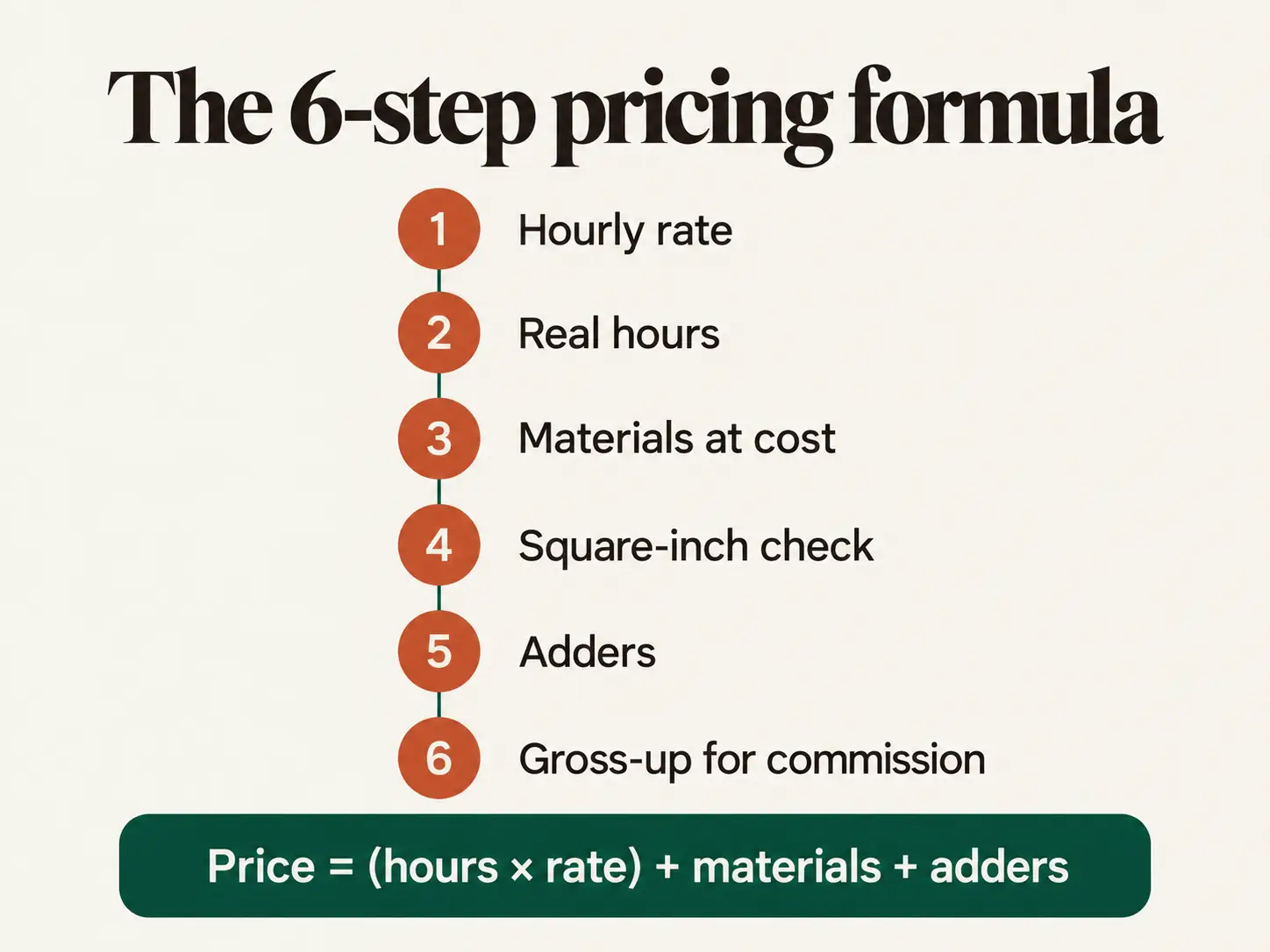
- Step 1: Set your hourly rate.
- Step 2: Count the real hours.
- Step 3: Add materials at actual cost.
- Step 4: Cross-check with a price per square inch.
- Step 5: Add adders for rush, extra subjects, and commercial use.
- Step 6: Work backward from what you want to keep.
Step 1: Set your hourly rate
Your hourly rate is the amount you want to earn for one hour of focused work, and it is the floor of every quote. Start with a number you would be glad to earn. Do not start with what the market "allows."
These example rates are not market data. Replace them with your own after your first few commissions.
- Starting out: ₱200 to ₱300 an hour.
- A small body of finished work and repeat clients: ₱300 to ₱500 an hour.
- A waitlist, exhibitions, or awards: ₱500 and up.
If a quote lands below your floor, you are paying the client to take your time.
Step 2: Count the real hours
Most artists count only painting time. Time one piece from start to finish with a phone timer and log each of these:
- Messages, reference photos, and the first sketch.
- Revisions to the sketch.
- Painting time, including drying and layering.
- Varnishing, photographing, and packing.
Add 10 to 20% for what you forget. A job you estimated at 14 hours is usually 16 once you count honestly.
Step 3: Add materials at actual cost
Materials are what you spent, not what you remember spending. Include canvas or board, paints, worn brushes, varnish, and the frame if you supply one.
If you used part of a roll of canvas, charge for the share you used. Keep receipts for your first few jobs until you can estimate quickly.
Step 4: Cross-check with a price per square inch
The most common formula for pricing paintings multiplies width by height by a price per square inch. It protects fast painters, because the price follows the size of the work the client can see.
In an Artists Network example, a 16 x 20 inch oil painting is 320 square inches. At $6 per square inch, the painting costs $1,920 before materials.
The same guide adds two rules:
- For much larger pieces, lower your rate per square inch a little, so you do not price past what your reputation can sustain.
- For small works, raise it, because a small piece takes almost as much effort as a big one.
A range of ₱10 to ₱20 per square inch is a reasonable test for acrylic or oil on canvas in the Philippines. This is a suggested starting point, not a published benchmark.
Now compare. If your hourly total is ₱5,900 and your square-inch total is ₱6,480, use ₱6,480.
Step 5: Add adders for rush, extra subjects, and commercial use
A single portrait on a plain background is your baseline. Anything beyond that takes more time or carries more value to the client, so it costs more.
| Situation | Suggested adder |
|---|---|
| Each additional person or pet | +30% |
| Detailed background (a street, a room, a landscape) | +20% |
| Rush job (under two weeks) | +30% |
| Commercial use (logo, packaging, merchandise, ads) | +50% to +100% |
| Each revision round past the first two | One extra hour at your hourly rate |
These are suggested starting points. Adjust them after your first five commissions, once you see which jobs ran long.
List each adder as its own line in the quote. A line that says "Rush fee" is easier to accept than a total that quietly jumped.
Step 6: Work backward from what you want to keep
If a gallery or platform takes a commission, your price must be higher for you to keep the same amount. The formula is: Listing price = target take-home ÷ (1 minus commission rate).
- Direct commission, no middleman: you keep 100%, so quote your total.
- A gallery that takes 50%: to keep ₱6,500, the price must be ₱13,000.
- Obramaestra's flat 15%: to keep ₱6,500, the price must be about ₱7,650.
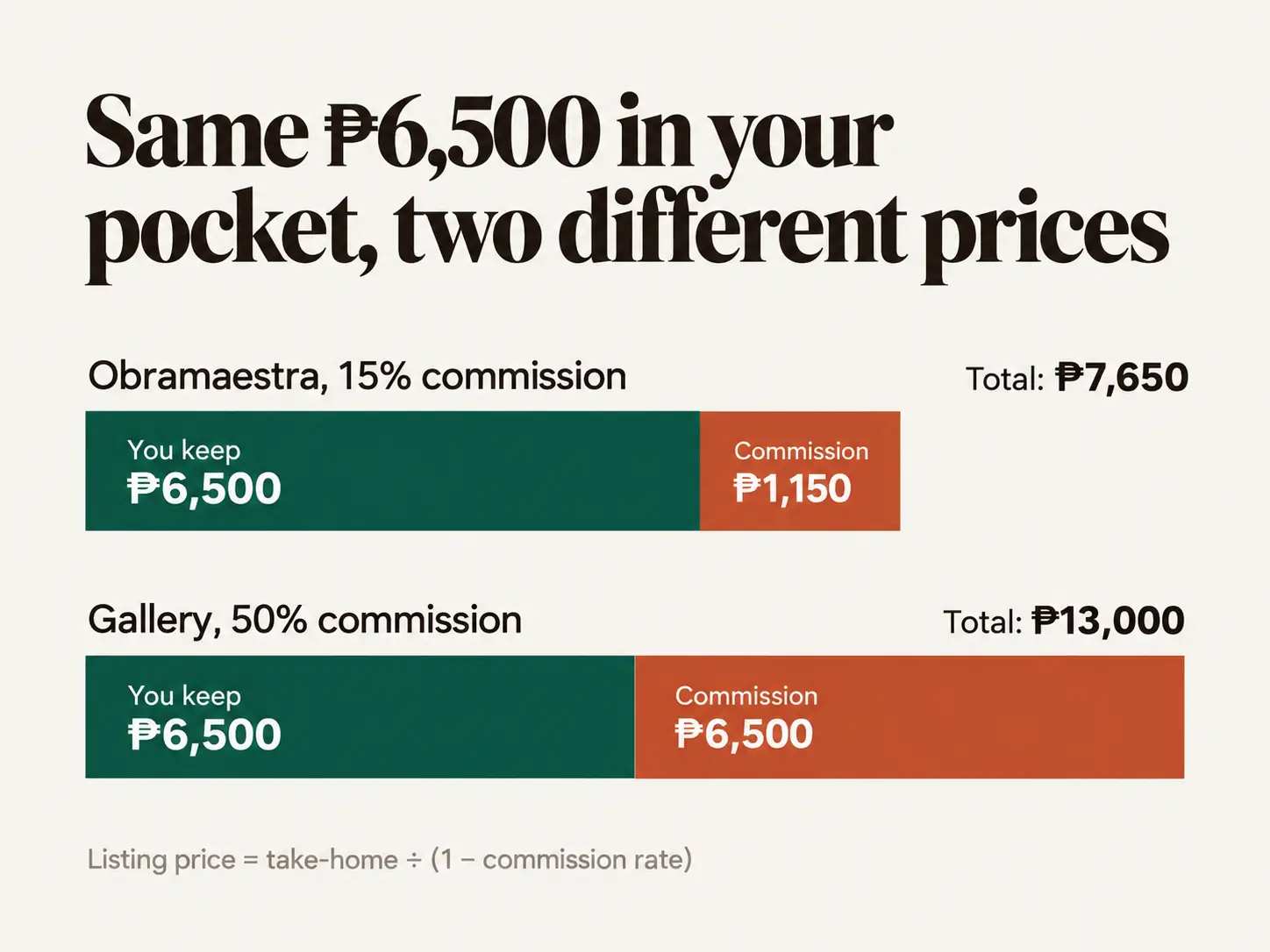
Do this before you list a finished original. Otherwise you find out after the sale that the commission ate your hourly rate.
A worked example: an 18 x 24 acrylic portrait
A client wants a portrait of two siblings in acrylic on canvas, with a simple background and a three-week deadline. This calculation uses an example rate of ₱300 an hour and ₱15 per square inch.
| Line | Calculation | Amount |
|---|---|---|
| Time | 16 hours × ₱300 | ₱4,800 |
| Materials | Canvas, paints, varnish | ₱1,100 |
| Hourly total | ₱5,900 | |
| Square-inch check | 18 × 24 = 432 sq in × ₱15 | ₱6,480 |
| Base price (higher of the two) | Rounded | ₱6,500 |
| Second person | +30% | ₱1,950 |
| Quote to client | ₱8,450 |
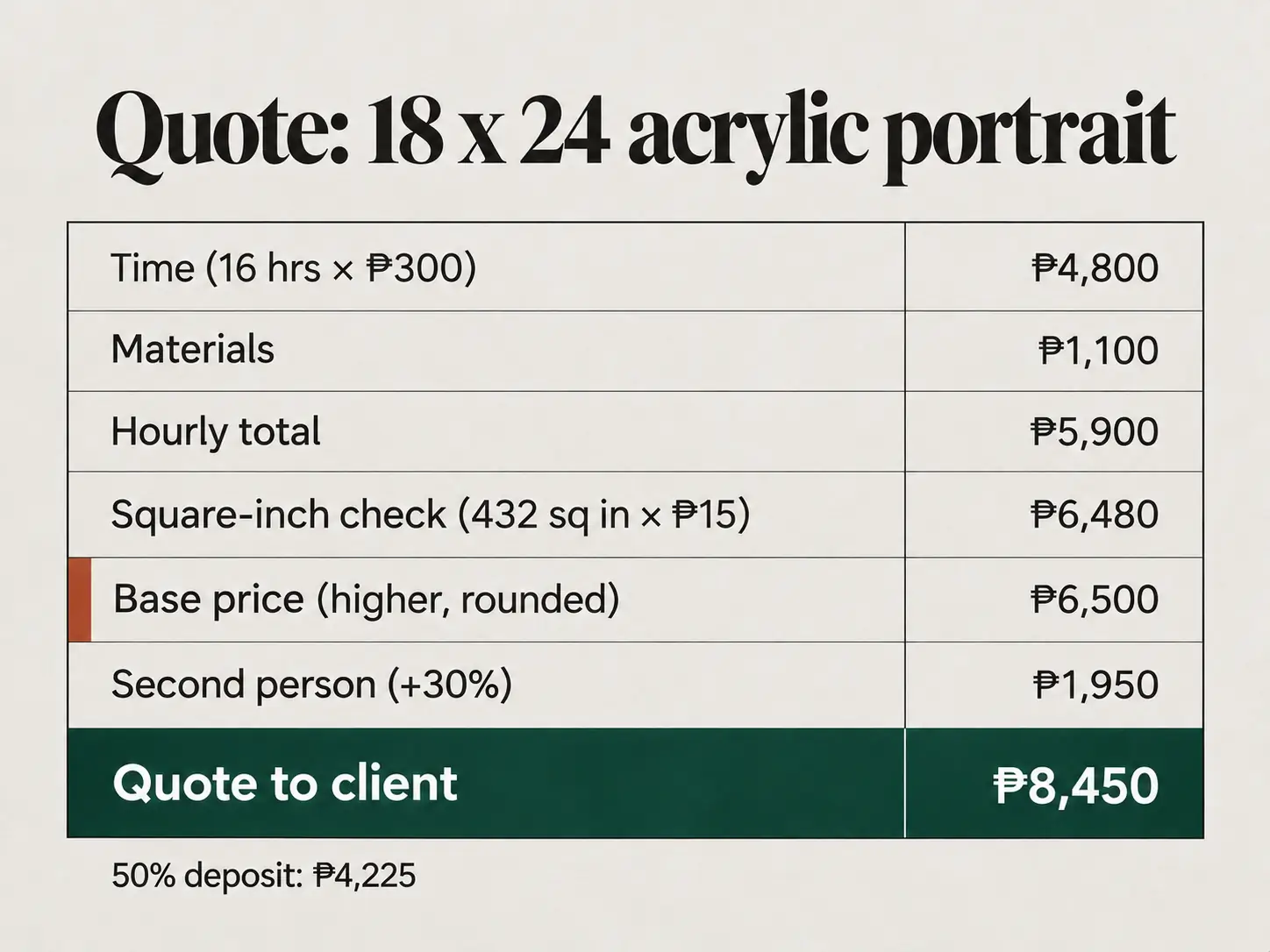
The client pays a 50% deposit of ₱4,225 to start, and the balance before delivery. A third round of changes costs one extra hour, or ₱300.
Now take a single-subject version of the same canvas, finished and listed as an original on Obramaestra. To keep ₱6,500, list it at ₱7,650. The listing form shows what you will receive before you publish, as the listing guide shows.
How much to charge for digital art
Digital art commissions follow the same formula, with two changes. Replace "materials" with your software, tablet, and storage costs spread across your work, and price the usage license separately.
Personal use, like a profile picture or a gift, sits at your base price. Commercial use, like a logo, a book cover, or merchandise, should cost more, because the client earns money from your work. The +50% to +100% adder in Step 5 is a starting point.
Obramaestra lists physical originals only, with no digital art or downloads. Use these steps to quote your digital jobs, and bring your canvas, paper, and mixed media work to Obramaestra.
Set the terms before you send the quote
A price is only half of a quote. The terms protect the other half.
- Deposit: 50% before you start, balance before delivery.
- Revisions: two rounds included, extra rounds billed by the hour.
- Timeline: a delivery date, with a rush fee if the client moves it up.
- Cancellation: the deposit is non-refundable once you have started the sketch.
- Shipping: quoted separately, to a Philippine address.
Put the terms in the same message as the price. Clear terms build trust, and vague ones invite disputes.
Raise your prices on a schedule
Consistent pricing builds credibility, and Artwork Archive notes that buyers like understanding how art is priced. Do not change your rate from client to client based on how much you want the job.
Review your rate every three to six months. Raise it by 10 to 15% when you have a waitlist, or when every quote is accepted the same day, which usually means you are too low.
Where Obramaestra fits
Commissions are one income stream. Finished originals are the other, and they can sell while you work on the next job. Obramaestra is built around the pricing problems above:
- No guessing what you will receive. The listing form shows your payout before you publish, at a flat 15% on every plan. See the Obramaestra pricing page.
- No chasing payment. Buyers pay into escrow, and payment releases automatically 14 days after you mark an order shipped. The how it works page shows the timeline.
- No 50% gallery cut. You sell directly to Filipino collectors, and orders ship within the Philippines.
Browse the originals to see where work like yours sits, and read Obramaestra's guide to the best platforms to sell art in the Philippines to compare your options.
If you also sell through Instagram DMs, our comparison of Instagram vs. Obramaestra shows the math on a ₱20,000 painting. To turn "magkano po?" comments into checkouts, see where to put your Obramaestra link.
Ready to price your first listing? Follow the step-by-step listing guide, then build an artist profile collectors trust. List three works with a complete profile and you qualify for the Founding 100 Artists program.
Frequently asked questions
Multiply your hours by your hourly rate, add materials at cost, and check the total against a price per square inch. Use the higher number, then add adders for rush work, extra subjects, or commercial use. For an 18 x 24 acrylic portrait at ₱300 an hour, the base price comes to about ₱6,500.
An 18 x 24 acrylic portrait with two subjects works out to about ₱8,450 at an example rate of ₱300 an hour and ₱15 per square inch. Your own number depends on your hourly rate, your hours, and your materials. Use the six steps above to calculate it.
A range of ₱10 to ₱20 per square inch is a sensible starting point for acrylic or oil on canvas in the Philippines. This is a suggested range, not an official benchmark. Lower the rate slightly for very large pieces and raise it for small ones.
The formula for pricing paintings is (hours × hourly rate) + materials, cross-checked against width × height × price per square inch. Use whichever total is higher. If a gallery or platform takes a commission, divide your target take-home by one minus the commission rate.
Charge for your hours at your hourly rate, add software and equipment costs, and price usage separately. Personal use sits at your base price, and commercial use typically costs 50% to 100% more. Obramaestra lists physical originals only, so Obramaestra does not sell digital art or downloads.
Ask for a 50% deposit before you start and the balance before delivery. A deposit confirms the client is serious and covers your materials if they cancel.
Obramaestra takes a flat 15% commission on every plan, so an artist keeps 85% of the selling price. On a ₱7,650 painting, the artist receives about ₱6,500. The buyer pays shipping at checkout, the shipping fee goes to the artist, and orders ship within the Philippines only.