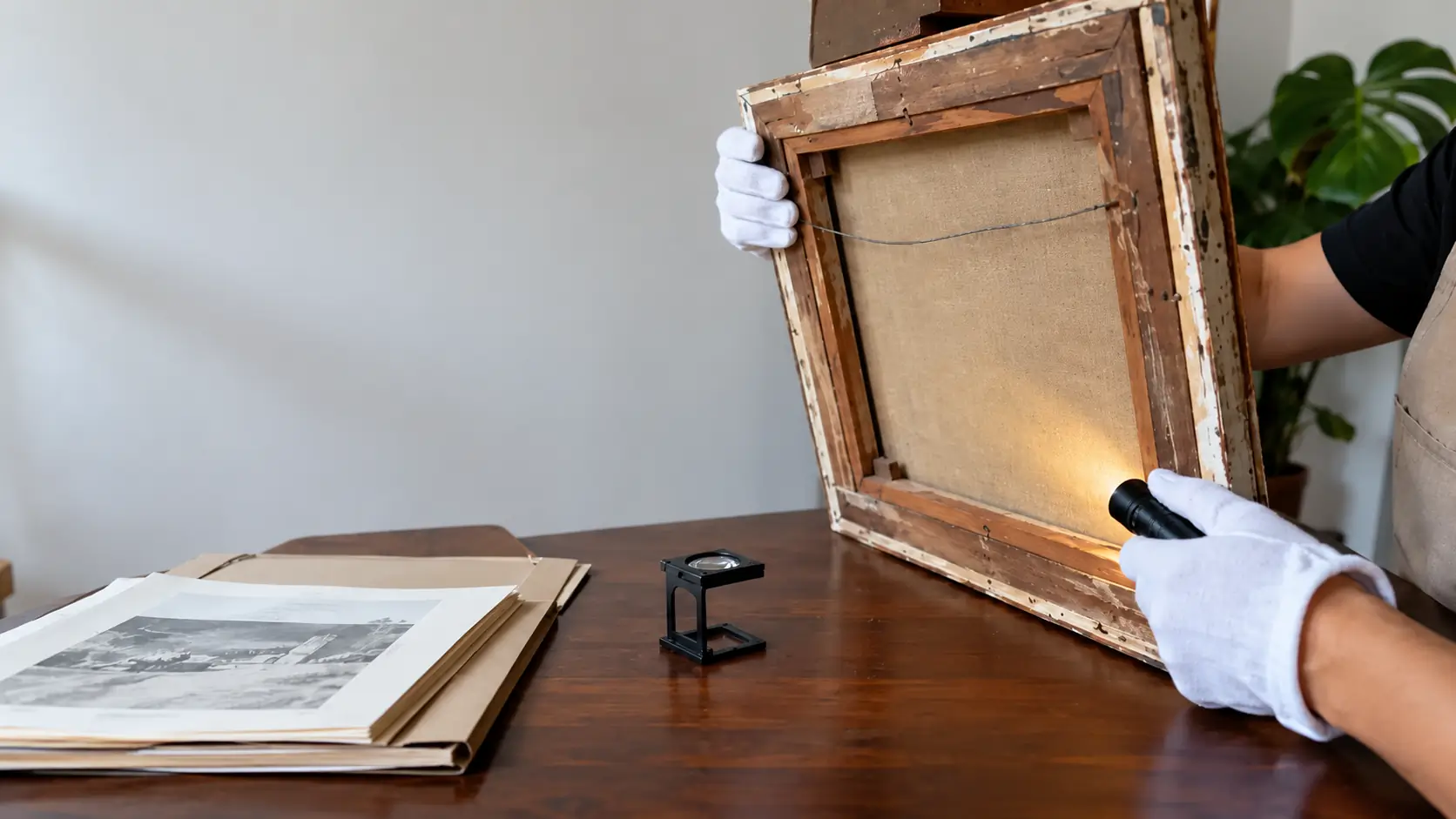
Sylvia Amorsolo-Lazo, daughter of National Artist Fernando Amorsolo, has long acted as custodian and authenticator of her father's work. At a 2013 ManilArt forum on art forgery, she said buyers sometimes get angry when she tells them a painting is fake, even when they hold a certificate from someone else (Inquirer).
That is the real problem with buying paintings in the Philippines.
The artwork can fool you, and so can the paperwork that comes with it.
This guide gives you a six-step check to verify authentic paintings in the Philippines before you pay. It works for a mid-century master on the secondary market and for a canvas by a living artist you found last week.
Why a certificate alone will not protect you
The Philippines does have a law for this. Republic Act 9105, the Art Forgery Act of 2001, defines art forgery and creates an Art Authentication Panel with the power to verify originals and issue certificates.
Most certificates a seller hands you are not from that panel. They come from the seller, a gallery, or a relative of the artist, so always ask who issued the paper and on what basis.
Here is what people who work in this market say about paper:
- A signature is not proof. At the same forum, Christian Aguilar, son of Federico Aguilar Alcuaz, said a signed paper, or a photo of the painting with a person beside it, legally means nothing. He pointed to poor documentation of works as the main weakness forgers exploit.
- Auction houses distrust certificates too. Richie Lerma of Salcedo Auctions has said that when a work's authenticity rests on a certificate alone, you should stay away, because certificates can be faked (Inquirer).
- Fake certificates are an old trick. A Philstar auction guide describes sellers waving photocopied certificates signed by an artist's relative or even household help.
So the goal is not to collect a certificate. The goal is to build a chain of evidence in which the certificate is one link.
How to verify authentic paintings in the Philippines: the six-step check
Run these in order. Each step is cheap, and any one of them can stop a bad purchase.
| Step | Ask for | Walk away if |
|---|---|---|
| 1. Provenance | Names of past owners, receipts, catalogs | "Private collection," and nothing more |
| 2. Certificate | Who issued it, and a way to reach them | The issuer can't be found or won't confirm |
| 3. The front | Clear photos of the signature and brushwork | It doesn't match documented works |
| 4. The back | Photos of the canvas, stretcher, and labels | The back is covered or hidden |
| 5. Second opinion | A conservator or specialist's written view | The seller won't allow an inspection |
| 6. Payment | Escrow or a written return clause | Only a transfer to a personal account |
Step 1: Trace the provenance. Provenance is the ownership history of a work, from the studio to the seller in front of you. Ask for names, years, and proof: a dated invoice, an exhibition catalog, a gallery receipt, or an auction record.
A real seller can usually name at least the last two owners. "From a private collection" with no names is a prompt for more questions, not an answer.
Step 2: Test the certificate. Find out who issued it, then contact that person or institution yourself, using contact details you looked up independently. Never use the phone number or email printed on the certificate.
A genuine certificate describes this exact work: title, medium, dimensions, year, and a photo. A generic paper that could fit any painting by that artist is worth very little.
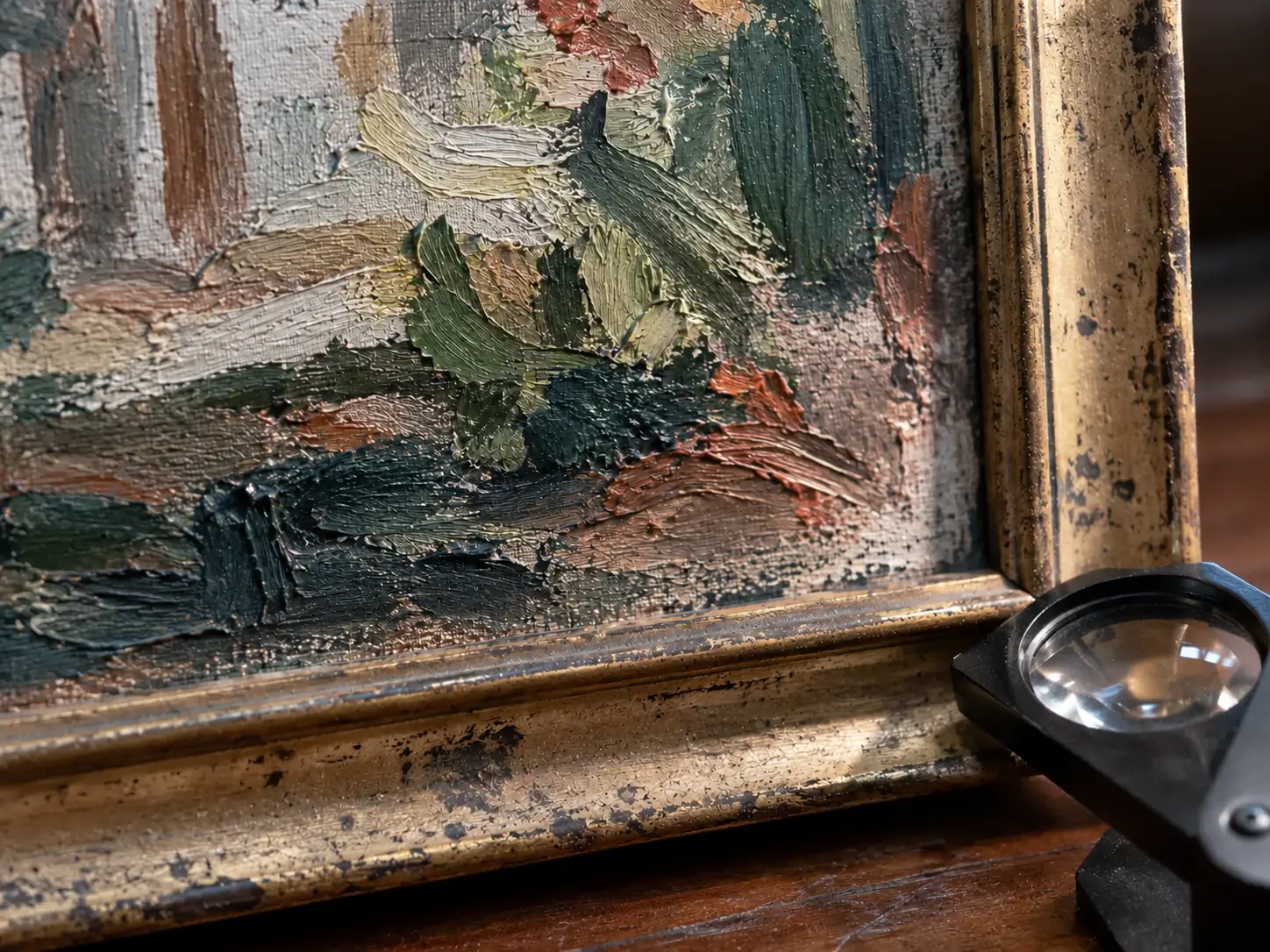
Step 3: Inspect the front. Compare the signature, placement, and handling against documented works by the same artist, such as auction lots and museum catalogs. Look at the paint under a raking light from the side, where genuine brushwork shows depth and a copy often looks flat.
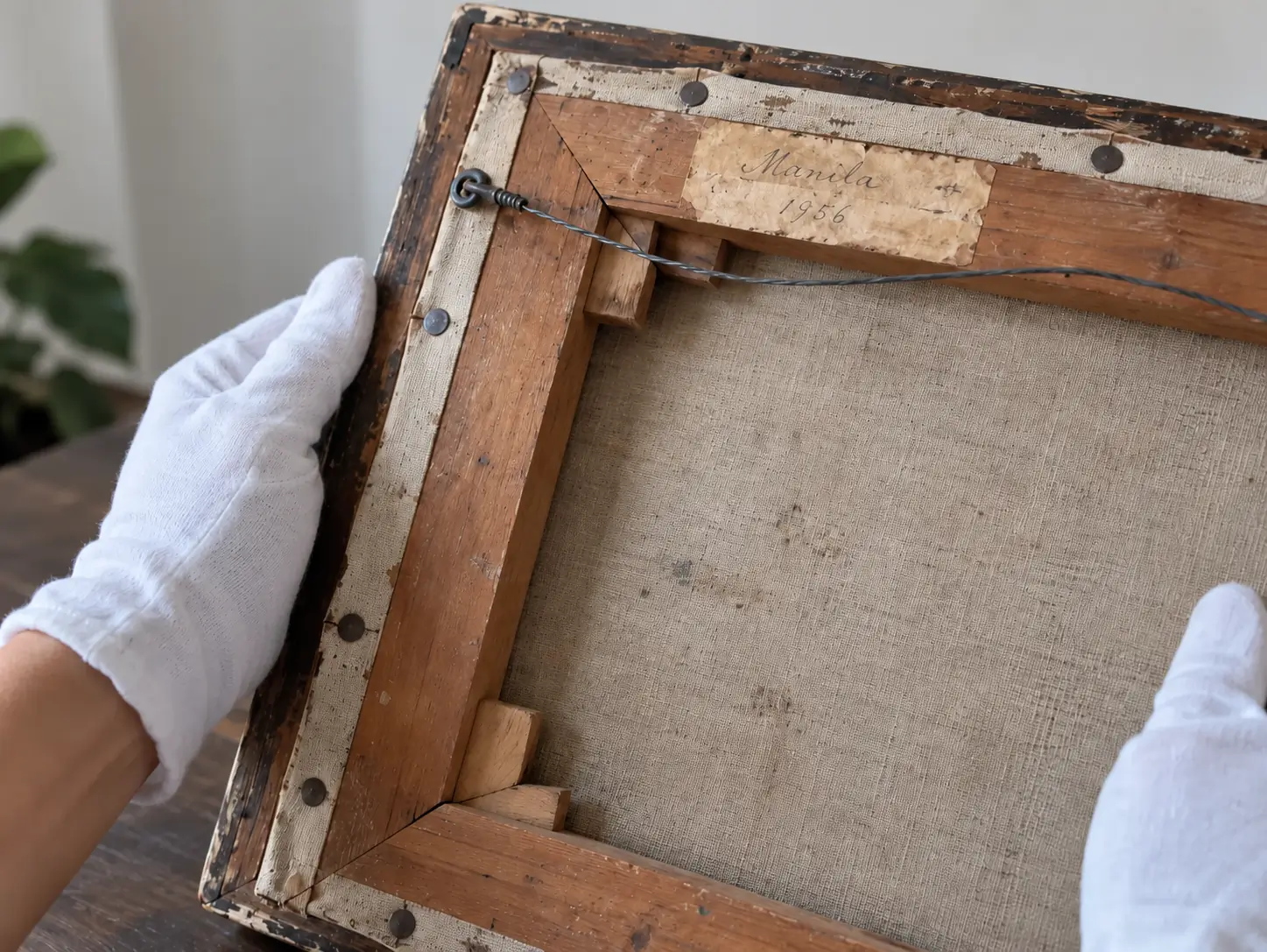
Step 4: Inspect the back. Turn the painting over, because forgers spend their effort on the front. Look at the canvas, stretcher bars, tacks, and any labels or inscriptions.
Paper glued over the back can hide the age or type of canvas, according to art fraud guidance from a US law firm. Edges that are perfectly clean, with no paint wrapping around, can also point to a mechanically produced piece.
Step 5: Get a second opinion. For anything priced above what you could comfortably lose, pay for a trained conservator or a specialist in that artist. For works by a master, ask the artist's estate or the recognized authenticator of that artist's work.
Researchers at the University of the Philippines have shown that lab methods work here. A UP Vargas Museum and National Institute of Physics team used 3D texture and spectral reflectance imaging on Amorsolo oils to help catch forgeries (ICOM-CC paper).
Step 6: Pay in a way you can reverse. A bank transfer to a personal account ends your leverage the moment you send it. Use escrow, a written receipt with a return clause, or an auction house with published terms.
If the seller refuses every protected payment method, that tells you what you need to know.
How to spot a fake Amorsolo (and other masters)
Amorsolo is one of the best-known names in Philippine painting, and his rural scenes are loved, recognizable, and expensive, which makes him a target. A genuine oil can sell for millions of pesos at auction.
His daughter has said imitators copied her father's work while he was still alive. She recalled one buyer who bought a forgery that turned out to come from one of her father's own students.
Use these checks when a painting claims to be by Amorsolo or another master:
- Check the light. Amorsolo is known for backlighting, where the sun sits behind figures and rims them with glow. A copy often gets the subject right and the light wrong.
- Match the details of the sale. A genuine lot in Leon Gallery's June 2021 sale carried a title, signature position, date, medium, exact dimensions, provenance, and the named person who confirmed authenticity. Your seller should be able to match that level of detail.
- Compare against dated, documented works. Look for the same subject, size, and period in auction records and catalogs before you trust the seller's story.
- Search for theft reports. Amorsolo's 1936 "Mango Harvesters" was stolen from a private museum in Silay City in 2024, then recovered when two people offered it for ₱3.5 million (Inquirer). A genuine painting can still be a stolen one.
- Treat a bargain as a red flag. A signed master at a fraction of auction prices is almost never a find.
A Philippine art provenance guide: what a clean paper trail looks like
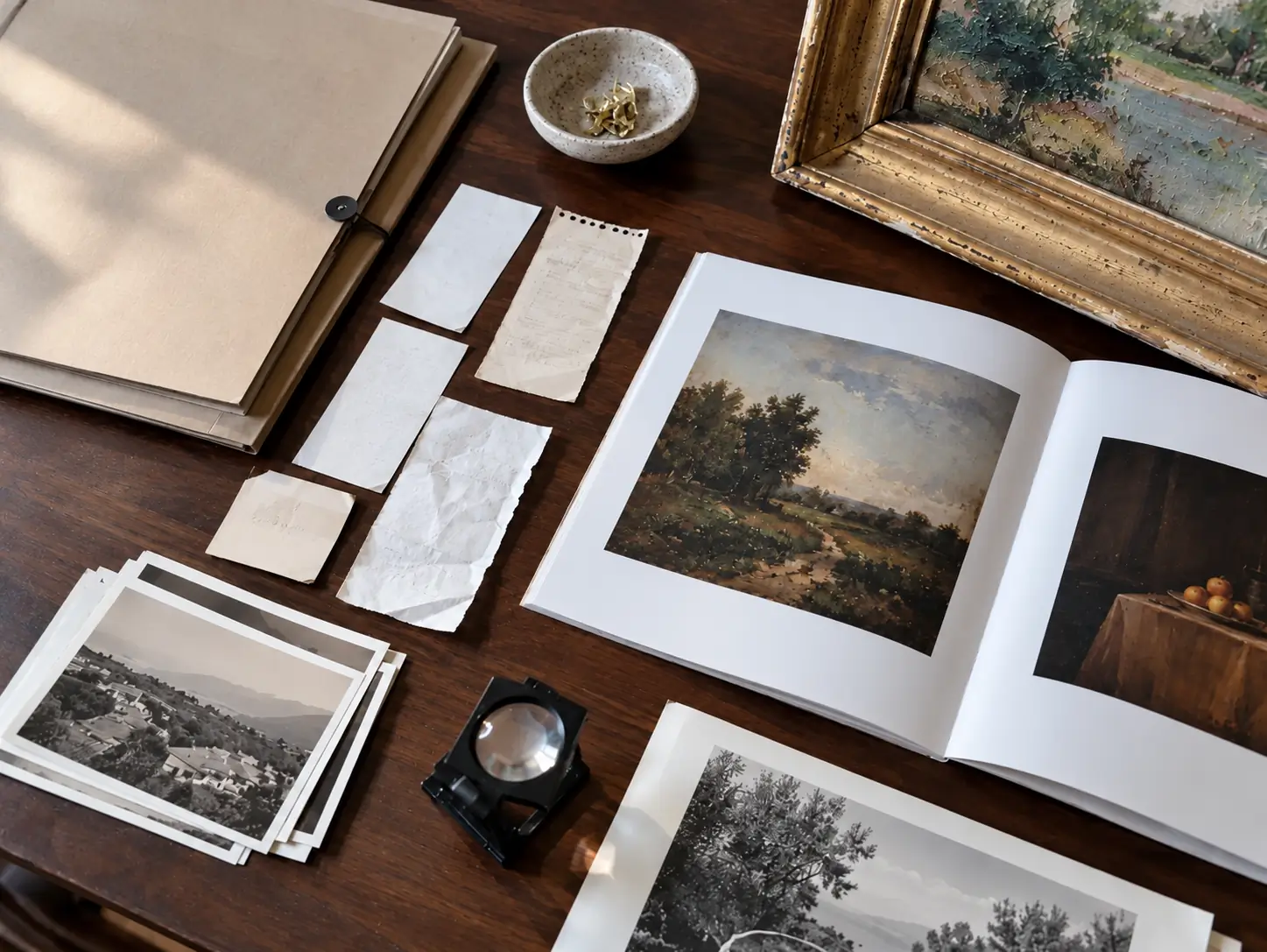
A good paper trail does not need to be fancy. It needs to be specific, dated, and checkable by someone other than the seller.
Ask for as many of these as the work's age and price justify:
- The sale history. Receipts, invoices, or gallery records that name the buyer and the date.
- Exhibition and publication records. A catalog, brochure, or article that shows the work.
- Auction records. Lot numbers, sale dates, and the house that handled it.
- The authenticator's opinion in writing. With their name, date, and the exact work described.
When you message a seller, send something like this:
"Hi, I'm interested in the painting. Before I decide, can you send the names of the previous owners, any receipts or catalogs that show the work, and who issued the certificate? Please include clear photos of the front, the back, and the signature."
A seller who has none of it may still be honest, but you are now buying on trust, and you should price the work that way.
How to verify modern Filipino art
With a living artist, like the ones in our list of emerging Filipino artists to collect in 2026, the risk changes. You are less likely to meet a forged masterpiece and more likely to meet a copy sold as an original, a print passed off as a painting, or a seller using someone else's photos.
The good news is that you can usually ask the artist directly. Use these checks:
- Confirm the artist is real and reachable. Look for a consistent body of work, a profile history, and a way to message them.
- Ask for the back and the signature. A photo of the back, a close-up of the signature, and a short video of the work in hand takes the artist two minutes and filters out most borrowed photos.
- Ask for process proof. Work-in-progress photos or a time-lapse are hard to fake for a one-of-one piece.
- Run a reverse image search. If the same image appears under several names or shops, walk away.
- Check that the signature matches. Compare against other pieces by the same artist, not just the one for sale.
The Philippines also has a good example of why asking the right person matters. When a watercolor attributed to former President Cory Aquino was offered to a gallery, her art teacher said it was fake, because she did not like working in watercolor, and her spokesperson noted that she never sold her paintings (Inquirer). The people closest to the work knew in minutes what a document could not show.
How Obramaestra handles this for you
Obramaestra is a marketplace where living Filipino artists sell their own originals, so the "who made this?" question starts from a better place. Here is how it maps to the checks above:
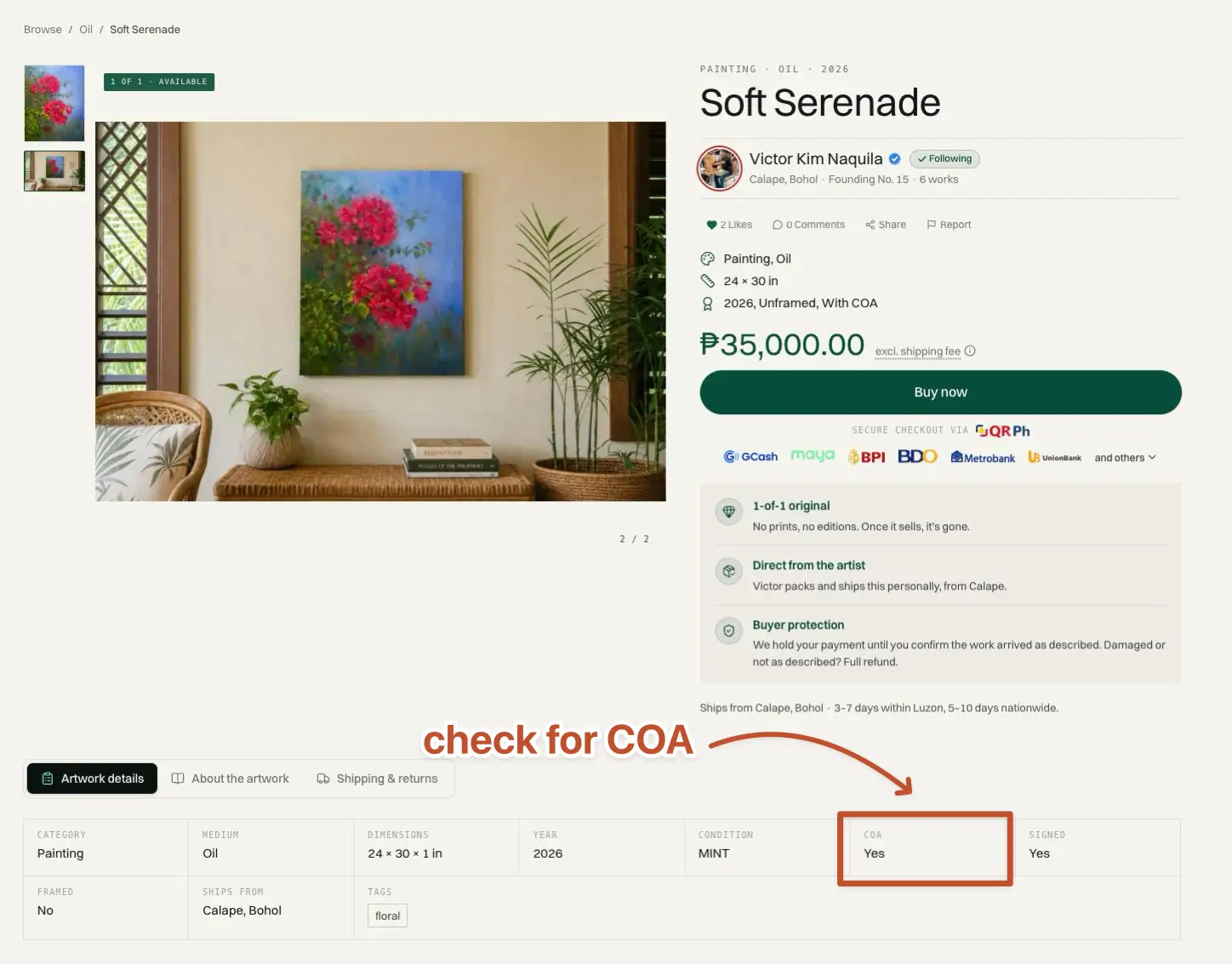
- Direct from the artist. Every listing shows the artist's profile, location, and other works. The artwork page for Calamansi by Eula Lu, for example, shows a Verified artist label, signed status, a COA field, and the year.
- A way to ask for proof. You can message the artist before you buy and ask for a photo of the back, the signature, or the work on a wall.
- One-of-one originals. No prints and no editions, so a listing is not an open-ended run.
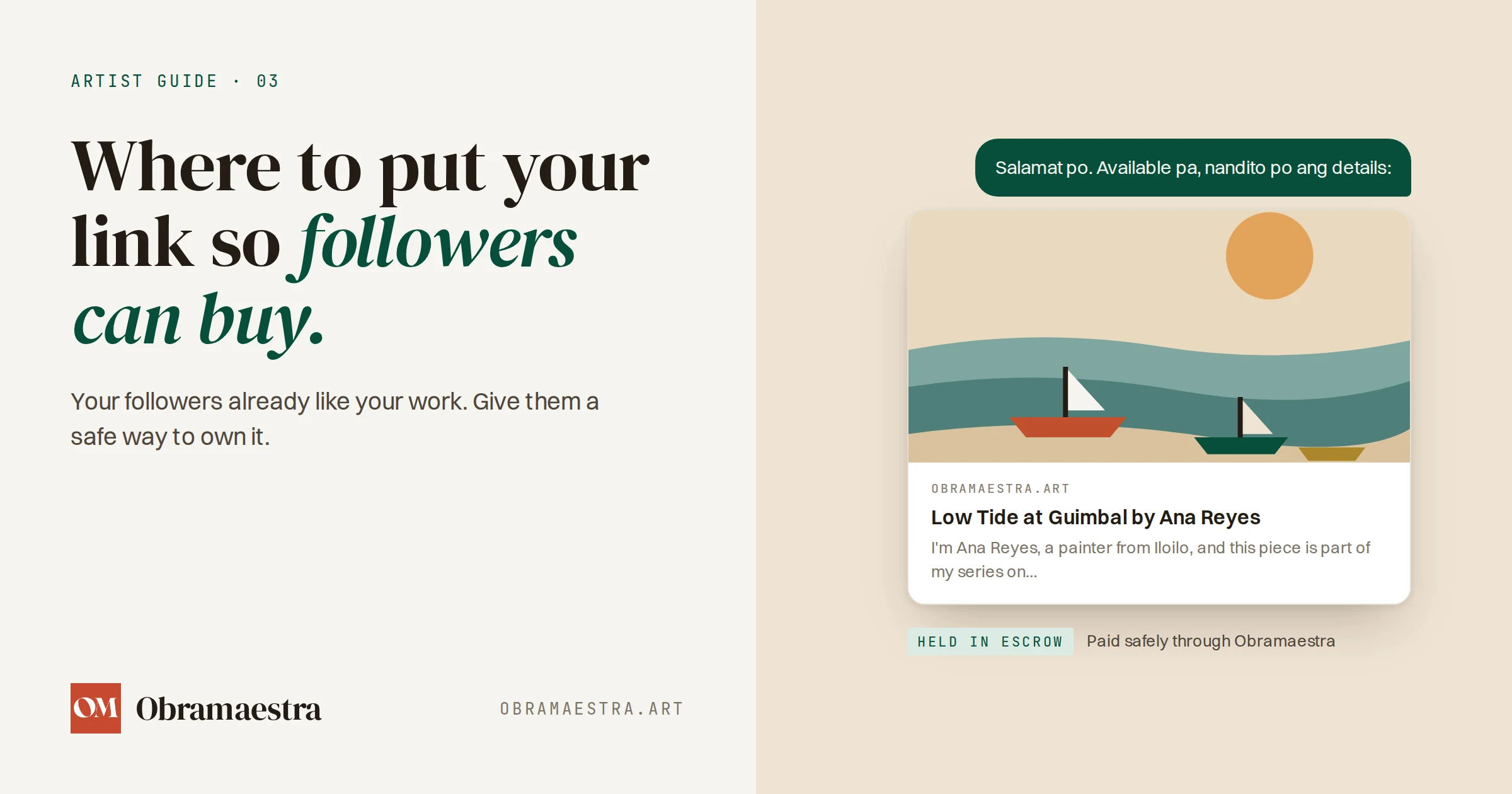
- Escrow and a claims window. Your payment is held until you confirm the work arrived as described, and you have 14 days to request a refund if it did not arrive, arrived damaged, or was not as described. Read the full terms on the returns page.
Obramaestra does not authenticate secondhand works by past masters. If you are buying an Amorsolo or a Luna, use the six steps above and buy from an auction house or the estate. Orders on Obramaestra ship within the Philippines only.
Your checklist before you pay
Save this list and run it on any painting over a few thousand pesos:
- Name the last two owners, or the artist if the work is new.
- Confirm who issued the certificate, and contact them yourself.
- Match the signature and style to documented works.
- See the back, the edges, and the stretcher.
- Search for the work in theft reports and auction records.
- Get a second opinion if the price would hurt to lose.
- Pay through escrow or a method you can reverse.
If you want to start with works from artists you can message directly, browse original paintings or see how buying works. For more on where to shop safely, read where to buy authentic Filipino art online.
Frequently asked questions
Run a six-step check: trace the provenance, verify the certificate with its issuer, inspect the front and back, get a second opinion from a conservator or specialist, and pay through escrow. No single document proves a painting is real, so you need several pieces of evidence that agree.
Compare the painting against dated, documented Amorsolo works and check the backlighting, signature, medium, and dimensions. Then ask the seller for provenance and the name of whoever authenticated it, and confirm that person independently. Amorsolo's daughter has said imitators copied the artist during his lifetime, so a convincing look is not enough.
No, a certificate of authenticity is not enough on its own, because certificates can be faked or issued without proper checks. Salcedo Auctions' Richie Lerma has said authenticity should not rest on a certificate alone. A useful certificate names the issuer, describes this exact work, and can be confirmed with the issuer directly.
The artist, the artist's estate or recognized authenticator, a specialist in that artist, or a trained conservator can authenticate a painting. Republic Act 9105 also creates an Art Authentication Panel with the power to certify original works. Ask any authenticator for a written opinion that names the work, the date, and their basis.
Message the artist and ask for photos of the back and the signature, work-in-progress images, and a short video of the piece. Then run a reverse image search and compare the signature with other works by the same artist. Obramaestra lists original paintings sold directly by Filipino artists, with escrow and a 14-day claims window if a work is not as described.
No, Obramaestra does not authenticate secondhand works by past masters. Obramaestra is a marketplace where living Filipino artists sell their own original work, with artist profiles, a COA field on each listing, and escrow-protected payment. For a master's painting, buy from an auction house or the artist's estate and apply the six-step check.